ANI
07 Jun 2026, 18:30 GMT+10
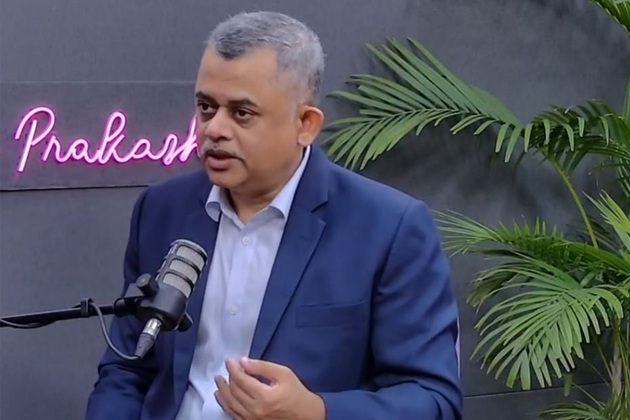
New Delhi [India], June 7 (ANI): As the Indian Rupee faces persistent volatility against the US Dollar, renowned economist and newly appointed Executive Director at the World Bank, Neelkanth Mishra, has offered a clear diagnosis: the current market turbulence is a 'liquidity problem,' not a fundamental solvency crisis.
Speaking with ANI, Mishra argued that the depreciation is less a reflection of India's economic health and more a symptom of a 'stampede' driven by panic among real-economy players.
Mishra said that with India's foreign debt/GDP very low, he argued the priority should be to end currency market panic quickly and provide visibility of $70-80-100 billion in capital inflows over the next two years.
Mishra emphasised that while the exact exchange rate level (such as crossing the 100-mark) is largely psychological, the volatility itself inflicts real damage on the economy.
Mishra said, 'The 100 barrier is just a number; 99, 100, 101 make no difference, but allowing wide swings from 95 to 105-110 damages the economy.'
He identified three primary negative impacts. Global investors, wary of sharp swings over two decades, demand a higher risk premium to compensate for uncertainty.
Investment decisions are being put on hold. Fund managers are increasingly adopting a 'wait and see' approach, telling the market, 'let the rupee settle and then we'll give you money.' This hesitation effectively costs India 1-2 years of potential growth.
Small and medium enterprises are often getting 'whipsawed,' hedging their positions too late at unfavourable rates, only to face further losses when the currency fluctuates back.
'First, it raises India's long-term cost of capital because global allocators see high currency volatility over 20 years and demand a higher risk premium. Second, it delays growth: fund managers with strong track records tell him, 'let the rupee settle and then we'll give you money,' so volatility costs India 1-2 years of growth. Third, SMEs get whipsawed. Citing his 2013 experience, he said small and medium firms hedge late -- at 98 -- and then lose again if the rupee moves to 93-94. 'It's important to have less volatility,' he stressed.
Explaining the mechanics, Mishra noted economists track BOP on an accrual basis, but the RBI faces cash demand. Between Oct 2025 and Mar 2026, the accrual BOP deficit was $24 billion, yet RBI intervention was $75 billion. The extra $50 billion came from importers over-hedging, SMEs hedging for the first time, and FPIs hedging India exposure after years of not doing so. He saw this in Singapore and Hong Kong in early May: 'people would never have hedged...had started to hedge.'
With exporters willing to sell 3-5 year dollars but importers desperate for 3-month cover, the market faces a classic supply-demand mismatch. 'There's no George Soros...it is small businesses, individuals panicking and making it worse.'
His first prescription: get 'done with the currency market panic.' Since it's a liquidity problem, India should show a path to $70-100 billion of inflows. He pointed to the press reports on withholding tax removal for bond investors under index inclusion -- Bloomberg Global Ag and FTSE indices benchmark $4.5 trillion.
India needs that exemption because cheap 7% bond capital is far better than 14-15% cost from PE/VC exits as funds repatriate gains. He also suggested a temporary WHT exemption on external commercial borrowings to trigger a borrowing flood.
If needed, use 'crowd control measures' like end-March, even if markets dislike them. Meanwhile, RBI's $690 billion reserves -- including gold and treasuries -- provide ample cover to intervene. You have $70-100 billion added to reserves...go short the currency if you want, I won't let it fall,' he said.
With oil futures at $80/barrel for March 2027, the $60 billion BOP deficit fear at $100 oil won't materialise, but markets won't believe it until volatility stops. Once the rupee stabilises, the narrative around India will stabilise automatically. (ANI)
Get a daily dose of South East Asia Post news through our daily email, its complimentary and keeps you fully up to date with world and business news as well.
Publish news of your business, community or sports group, personnel appointments, major event and more by submitting a news release to South East Asia Post.
More InformationPARIS, France: U.S. Defense Secretary Pete Hegseth used a speech marking the anniversary of the D-Day landings to urge European countries...
OSLO, Norway: Norway's Crown Princess Mette-Marit has been put on a waiting list for a lung transplant after her health got worse,...
TIRANA, Albania: Thousands of people in Tirana protested this week against a plan to build a luxury resort on a sensitive stretch of...
DIBBINE, Lebanon: Israel's air force carried out strikes in several areas of southern Lebanon on June 5, and the military told people...
SEOUL, South Korea: North Korea, on June 4, revealed a new facility for producing fuel used in nuclear weapons, with leader Kim Jong...
DUBLIN, Ireland: A general practitioner and former member of the Medical Council has been found guilty of professional misconduct because...
WASHINGTON, D.C.: The U.S. labor market continued to outperform expectations in May, with employers adding more jobs than forecast...
DARTFORD, England: Amazon introduced a new generation of AI-powered warehouse robot capable of responding to conversational instructions,...
NEW YORK CITY, New York: SpaceX is preparing for what could become the largest initial public offering in history, a deal that may...
NEW YORK CITY, New York: Quantinuum, the quantum computing company backed by Honeywell, saw its shares rise sharply in its Nasdaq debut...
TORONTO, Ontario: The Canadian dollar traded near an eight-week low against the U.S. dollar on Friday as investors looked ahead to...
NEW YORK, New York - U.S. stock markets suffered a brutal beating on Friday, with the tech-heavy NASDAQ leading a dramatic sell-off...